segunda-feira, 18 de maio de 2020

Linux/AirDropBot Samples


Reference


Download

       
      Other malware


Hashes

MD5
SHA256
SHA1
85a8aad8d938c44c3f3f51089a60ec16
1a75642976449d37acd14b19f67ed7d69499c41aa6304e78c7b2d977e0910e37
2f0079bb42d5088f1fec341cb68f15cdd447ac43
2c0afe7b13cdd642336ccc7b3e952d8d
64c0e594d4926a293a1f1771187db8cfb44a0dda80d8b25b4f0c975e1e77745c
fef65085a92654cbcf1e3e0d851c6cda8dd3b03d
94b8337a2d217286775bcc36d9c862d2
71c02b99046c3be12e31577aa6623ce47dfb7f369e67af564d2bd499080c03b6
d5deeb1b61026479acb421583b7b82d09d63e921
417151777eaaccfc62f778d33fd183ff
bf6941e644a430fef43afc749479859665a57b711d5483c2c7072049c7db17b7
f76b9447db23229edae17a3160e04df41bc35a9d
d31f047c125deb4c2f879d88b083b9d5
2785845c97a69e15c9c1535216732a9d24bcf8f7244ce7872a2b0d2d4bcb92c3
4693505ef4c029112c4b85a16762cf90f0d69c15
ff1eb225f31e5c29dde47c147f40627e
f7ab3d315961d84da43f30a186136a56f5aa1e9afe6b56a0d357accd5f0ab81a
d5f2a976b703b5e687ffc58c408e0bc880838ae7
f3aed39202b51afdd1354adc8362d6bf
fa2bc8d988c8dfbdc965f1373bd80e9f5862868397c1bcb5e84b1e9c1756e0e2
31f0bca917cfbffcc126219439d38fe80d5c8460
083a5f463cb84f7ae8868cb2eb6a22eb
d654850f7785a5adb34f0808e2952f66e3784c0a32427fab9e97c75f0a48d9f5
ed4359a2805ce69771253d2257598b5c63c36c8e
9ce4decd27c303a44ab2e187625934f3
a2a245f12ae44cca79f03a465e2dc3dfa222dfcfda1017824b16abf397f16255
710e85ae3d362d3c8f3759319c308ff9b4dcdc86
b6c6c1b2e89de81db8633144f4cb4b7d
2480be0d00193250bc9eb50b35403399ed44f53d5d919600ee5bab14ef769530
ee77141054ac8d2fad062bcd79832b5f481c7dfb
abd5008522f69cca92f8eefeb5f160e2
509299df2f6150f59ed777873d3b7c708587c68a4004b4654a8cf2a640dd50aa
15cf94828c07e080b9c455738f3219859d9ab732
a84bbf660ace4f0159f3d13e058235e9
565deb4b1a7397d2497c75c9635b81d2e3b6427f0c576e5cd3c4224660712b56
c56fea8c1c949394e539d5ab3e3df7dfd329844a
5fec65455bd8c842d672171d475460b6
121c7ebfb99d8ef39f72bf7c787be4c15e2e08b731f01172605a4d34d27f08eb
3b6ca4525c3aad0583400b911b015071a0ea6133
4d3cab2d0c51081e509ad25fbd7ff596
7f71577b63b449c1a9e9aa516fa9e4320fe5f79548a00025a430894a269ab57b
d521f25362791de4d8a82a2683f032c1dd816e74
252e2dfdf04290e7e9fc3c4d61bb3529
834fc5c0ccfde1f3d52d88355717f119221118ee2d26018b417c50d066e9e978
c8f3130e64a6f825b1e97060cf258e9086a2b650
5dcdace449052a596bce05328bd23a3b
22949a7a3424f3b3bdf7d92c5e7a7a0de4eb6bbe9c523d57469944f6a8b1d012
f2c072560559a3f112e2000c8e28ee975b2b9db3
9c66fbe776a97a8613bfa983c7dca149
18c08d3c39170652d4770b2f7785e402b58c1f6c51ba1338be4330498ef268f4
18a99ec770109357d1adbc1c2475b17d4dcca651
59af44a74873ac034bd24ca1c3275af5
1c345b5e7c7fdcc79daa5829e0f93f6ae2646f493ae0ec5e8d66ab84a12a2426
98f789e91809203fbf1b7255bd0579fc86a982ba
9642b8aff1fda24baa6abe0aa8c8b173
98165c65d83fd95379e2e7878ac690c492ac54143d7b12beec525a9d048bedae
bd447e0e77a9192b29da032db8e1216b7b97f9ed
e56cec6001f2f6efc0ad7c2fb840aceb
7a2bf405c5d75e4294c980a26d32e80e108908241751de4c556298826f0960f1
b1c271d11797baac2504916ac80fd9e6fac61973
54d93673f9539f1914008cfe8fd2bbdd
c396a1214956eb35c89b62abc68f7d9e1e5bd0e487f330ed692dd49afed37d5a
72a9b8d499cce2de352644a8ffeb63fd0edd414b
6d202084d4f25a0aa2225589dab536e7
c691fecb7f0d121b5a9b8b807c5767ad17ae3dd9981c47f114d253615d0ef171
a68149c19bfddcdfc537811a3a78cd48c7c74740
cfbf1bd882ae7b87d4b04122d2ab42cb
892986403d33acb57fca1f61fc87d088b721bdd4b8de3cd99942e1735188125b
a067a0cf99650345a32a65f5bc14ab0da97789b6

Continue reading


  1. Curso Hacking Etico Gratis
  2. Brain Hacking
  3. Hacking Forums

The Live HTML Editor


The Live HTML Editor program lets you write your HTML pages while viewing dynamically what changes are happening to your HTML page. The main purpose of this tool is to help HTML learners learn HTML quickly and easily while keeping an eye on what they are doing with their HTML page. It also helps developers in writing quick HTML lines to see how it will affect their HTML page.

This program can also help you visualize your inline and embedded CSS styles on fly. You can apply CSS styles and see them dynamically change the look and feel of your HTML page. Developers can test different inline and embedded CSS styles to make sure what will look good on their website.

Some of the features of this program are:
  •          Live HTML preview of whatever HTML you type.
  •          Supports HTML Syntax Highlighting.
  •          Supports opening an HTML file and Live Preview editing of that file.
  •          Supports Saving files.
  •          Support for inline and embedded CSS.

However this program does not support Javascript and it also doesn't support separate CSS files. This program is still in development phase and we might see support for Javascript and separate CSS files in the future.

If you are a student and want to learn HTML without having to install a bulky software that takes a lot of time to open and function, then this is a good option.

The Live HTML Editor is Free and Opensource project and has been written in Python with QT interface you can check out source from sourceforge.
More information

domingo, 17 de maio de 2020

Hidden-Cry - Windows Crypter/Decrypter Generator With AES 256 Bits Key


Windows Crypter/Decrypter Generator with AES 256 bits key

Features:
  • Works on WAN: Port Forwarding by Serveo.net
  • Fully Undetectable (FUD) -> Don't Upload to virustotal.com!

Legal disclaimer:
Usage of Hidden-Cry for attacking targets without prior mutual consent is illegal. It's the end user's responsibility to obey all applicable local, state and federal laws. Developers assume no liability and are not responsible for any misuse or damage caused by this program

Usage:
git clone https://github.com/thelinuxchoice/hidden-cry
cd hidden-cry
apt-get update & apt-get install mingw-w64 -y
chmod +x hidden-cry
./hidden-cry

Author: github.com/thelinuxchoice
IG: instagram.com/linux_choice


via KitPloit

Related word


What Is Cybercrime? What Are The Types Of Cybercrime? What Is Cyberlaw In India?

What is cyber crime?

Cybercrime is the use of computers & networks to perform illegal activities such as spreading viruses,online  bullying,performing unauthorized electronic fund transfers etc. Most cyber crimes are committed through the internet.
Some cyber crime also be carried out using mobile phones via Sms and online chatting applications.

TYPES OF CYBERCRIME

The following list presents the common types of cybercrimes-

1-Computer Fraud-Intential deception for personal gain via the use of computer system.

2-Privacy Violations-Exposing personal information such as email addresses,phone numbers,account details etc, on social media,websites,etc.

3-Identity theft-Stealing personal information from somebody and impersonating that person.

4-Sharing copyright files/information-This involves distributing copyright protected files such as eBooks and computer program etc.

5-Electronic funds transfer-This involves gaining an unauthorized access to bank computer networks and making illegal funds transferring.

6-Electronic money laundering-This involves the use of the computer to launder money.

7-Atm fraud-This involves intercepting ATM card details such as account numbers and PIN numbers.These details are then used to withdraw funds from the intercepted accounts.

8-Denial of service attack-This involves the use of computers in multiple locations to attack servers with a view of shutting them down.

9-Spam:sending unauthorized emails.
These emails usually contain advertisements.


CYBER LAW

Under The Information Technology Act,2000 
CHAPTER XI-OFFENCES-66. Hacking with computer system.

1-whoever with the Intent to cause or knowing that he is likely to cause Wrongfull Loss or Damage to the public or any person Destroys or Deletes or Alter any Information Residing in computer Resource or diminishes its value or utility or affects it injuriously by any means, commits hack.

2-whoever commits hacking shell be punished with imprisonment up to three years, or  with fine which may extend up to two lakh rupees,or with both.
More information

sábado, 16 de maio de 2020

CEH: 10 Hacking Tools For Hackers


There are a lot of hacking tools available over the internet but mostly we need some of them. In this blog you'll learn about hacking tools which are typically used in the world of hacking by penetration testers.

SmartWhois

SmartWhois is an information-gathering program that allows you to find all available information about an IP address, hostname, or domain, including country, state or province, city, name of the network provider, administrator, and technical support contact information. SmartWhois is a graphical version of the basic Whois program.

SocksChain

SocksChain is a tool that gives a hacker the ability to attack through a chain of proxy servers. The main purpose of doing this is to hide the hacker's real IP address and therefore minimize the chance of detection. When a hacker works through several proxy servers in series, it's much harder to locate the hacker. Tracking the attacker's IP address through the logs of several proxy servers is complex and tedious work. If one of the proxy servers' log files is lost or incomplete, the chain is broken, and the hacker's IP address remains anonymous.

NeoTrace, VisualRoute, and VisualLookout

NeoTrace, VisualRoute, and VisualLookout are all packet-tracking tools with a GUI or visual interface. They plot the path the packets travel on a map and can visually identify the locations of routers and other internet working devices. These tools operate similarly to traceroute and perform the same information gathering; however, they provide a visual representation of the results.

Visualware's eMailTrackerPro

Visualware's eMailTrackerPro ( www.emailtrackerpro.com/ ) and MailTracking ( http://mailtracking.com/ ) are tools that allow an ethical hacker to track email messages. When you use these tools to send an email, forward an email, reply to an email, or modify an email, the resulting actions and tracks of the original email are logged. The sender is notified of all actions performed on the tracked email by an automatically generated email.

IPEye

IPEye is a TCP port scanner that can do SYN, FIN, Null, and XMAS scans. It's a command line tool.
IPEye probes the ports on a target system and responds with closed, reject, drop, or open. Closed means there is a computer on the other end, but it doesn't listen at the port. Reject means a firewall is rejecting the connection to the port (sending a reset back). Drop means a firewall is dropping everything to the port, or there is no computer on the other end. Open means some kind of service is listening at the port. These responses help a hacker identify what type of system is responding.

IPSecScan

IPSecScan is a tool that can scan either a single IP address or a range of addresses looking for systems that are IPSec enabled that means the system has IPSec enabled while disabled means that it either has IPSec disabled, the compatibility issue or the configuration issue that not reveal to you that it has IPSec enabled. Indeterminable means that the scanner isn't sure if IPSec is enabled or disabled.

Icmpenum

Icmpenum uses not only ICMP Echo packets to probe networks, but also ICMP Timestamp and ICMP Information packets. Furthermore, it supports spoofing and sniffing for reply packets. Icmpenum is great for scanning networks when the firewall blocks ICMP Echo packets but fails to block Timestamp or Information packets.

SNMP Scanner

SNMP Scanner allows you to scan a range or list of hosts performing ping, DNS, and Simple Network Management Protocol (SNMP) queries. This tool helps you to find out the current information about the device of SNMP nodes in the given network.

hping2 tool

The hping2 tool is notable because it contains a host of other features besides OS fingerprinting such as TCP, User Datagram Protocol (UDP), ICMP, and raw-IP ping protocols, traceroute mode, and the ability to send files between the source and target system.

THC-Scan, PhoneSweep, and TeleSweep

THC-Scan, PhoneSweep, and TeleSweep are tools that identify phone numbers and can dial a target to make a connection with a computer modem. These tools generally work by using a predetermined list of common usernames and passwords in an attempt to gain access to the system. Most remote-access dial-in connections aren't secured with a password or use very rudimentary security.More articles

Ufonet - Dos And Ddos Attack Tool | How To Install Bot

More information

How To Change Facebook’s Default Theme To Any Color You Want

Change Facebook Theme Using Chrome Extension

How To Change Facebook's Default Theme To Any Color You Want

We are going to share an interesting trick on changing your Facebook default theme. You just need a Google Chrome extension to perform this trick. If you are among me who feels very fatigued with the look of Facebook's by default theme then this is a must-see post because you will find out the easiest trick to make your facebook more attractive than before.

Facebook is a social networking site which empowers people to connect with friends and people around. That's how Facebook is habitually introduced. However, Facebook is beyond the need of being introduced as almost everyone is on it.
   A couple of Days ago I was simply Surfing Google Chrome website and I somehow stumbled upon a Chrome Extension. Yes, a Chrome extension that will give your Facebook a Whole new look. I was apprehensive to try it, So I just installed it and checked my facebook. I was astonished to see my facebook homepage have all new look. I found it refreshing and decided to write steps on How to Change Facebook Themes using Chrome Extension.

How To Change Facebook's Default Theme To Any Color You Want

If You are among me who feels very fatigued with the look of Facebook's by default theme then this is a must-see post, Because you will find out the easiest trick to make your facebook more attractive than before. Simply follow the steps to know about it.

How to Change Facebook Theme Using Chrome Extension

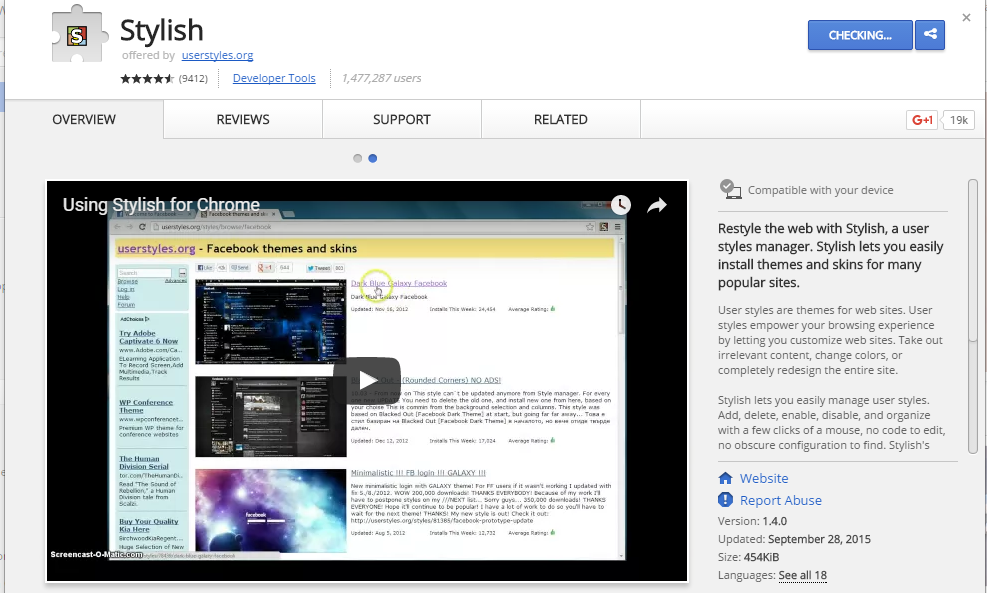
Step 1. Install Stylish for Chrome from the Chrome Web Store. It will take hardly a minute to get installed in your Chrome browser.
Change Facebook Theme Using Chrome Extension
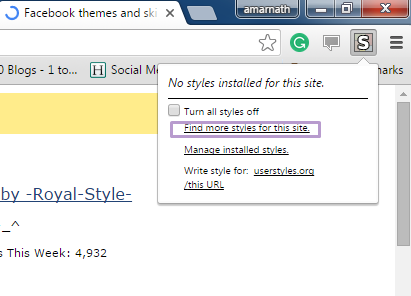
Step 2. Navigate to Facebook.com and click on the S button. Click on Find Styles for this Site to open a new tab with free themes to use for Facebook. Most of the themes are free and attractive too you can easily browse over the full website to discover your favorite theme.
Change Facebook Theme Using Chrome Extension
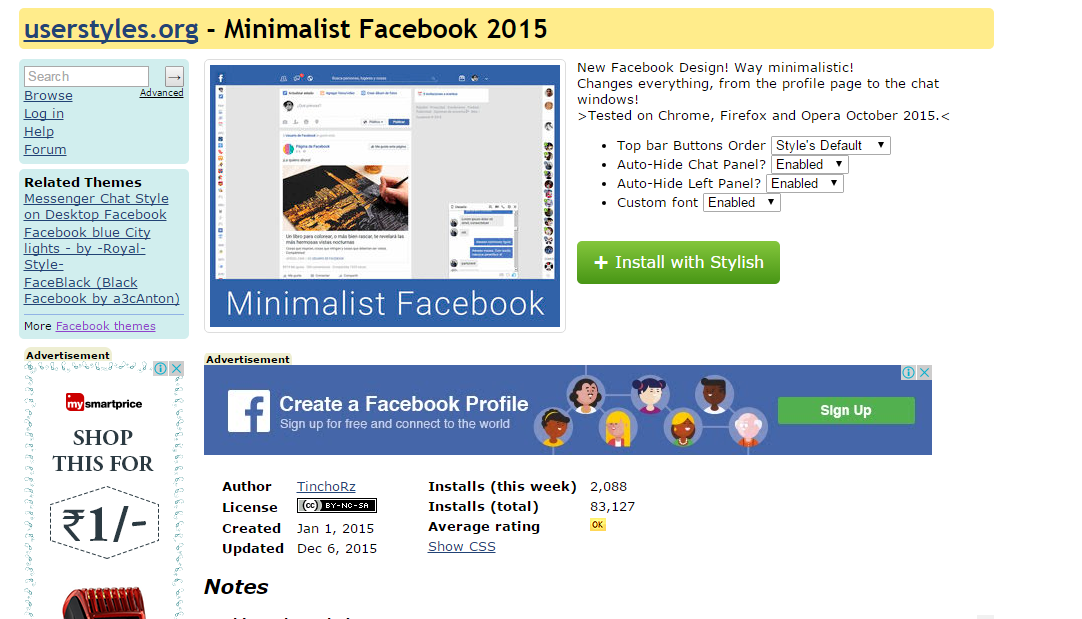
Step 3. Now You will be redirected towards https://userstyles.org Guess what! This site contains huge numbers of Facebook themes, One thing is for sure that you will be confused in-between what to select and which one to skip. Select any them and click on it. Now you will be given a full preview of your selected theme.
Change Facebook Theme Using Chrome Extension
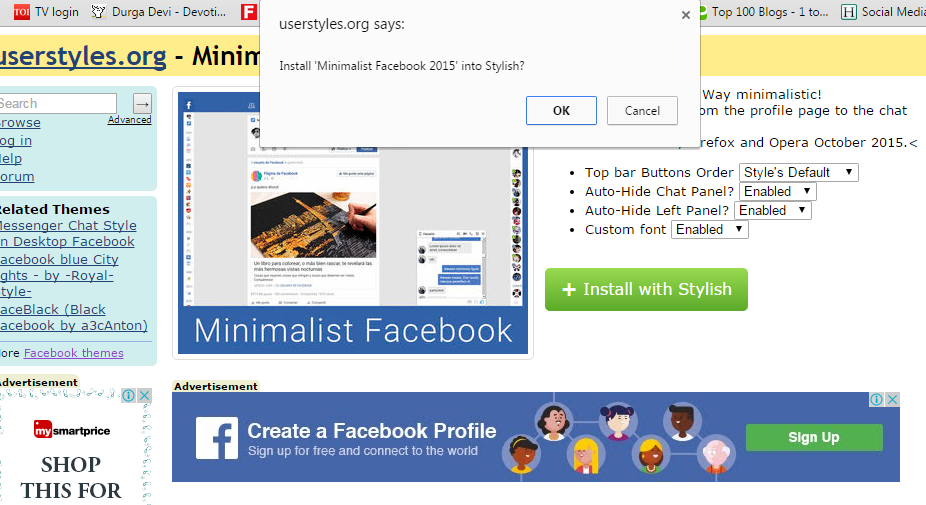
Step 4. If everything is fine in the previewed theme, click on Install with Stylish button at the top right corner of the page. It will take few seconds or minutes depends on your theme size to be installed in Stylish Extension, once installed you will be notified with a success message.
Change Facebook Theme Using Chrome Extension
Step 5. Now whenever you open Facebook, it will show the theme that you have installed with Stylish instead of the boring old blue theme.
Change Facebook Theme Using Chrome Extension

More info


  1. Hacking Software
  2. House Hacking
  3. Hacking Y Seguridad
  4. Como Ser Hacker
  5. Hacking Games
  6. Hacking Hardware Tools
  7. Growth Hacking Courses
  8. Curso Seguridad Informatica

sexta-feira, 15 de maio de 2020

Advanced Penetration Testing • Hacking The World'S Most Secure Networks Free PDF

Related news
  1. Tecnicas De Ingenieria Social
  2. Hacking Forums
  3. Nfc Hacking
  4. Tools For Hacking Wifi
  5. Hacking Academy

Kali Linux 2018.3 Release - Penetration Testing And Ethical Hacking Linux Distribution


Kali 2018.3 brings the kernel up to version 4.17.0 and while 4.17.0 did not introduce many changes, 4.16.0 had a huge number of additions and improvements including more Spectre and Meltdown fixes, improved power management, and better GPU support.

New Tools and Tool Upgrades

Since our last release, we have added a number of new tools to the repositories, including:
  • idb – An iOS research / penetration testing tool
  • gdb-peda – Python Exploit Development Assistance for GDB
  • datasploit – OSINT Framework to perform various recon techniques
  • kerberoast – Kerberos assessment tools

In addition to these new packages, we have also upgraded a number of tools in our repos including aircrack-ng, burpsuite, openvas,wifite, and wpscan.
For the complete list of updates, fixes, and additions, please refer to the Kali Bug Tracker Changelog.

Download Kali Linux 2018.3


If you would like to check out this latest and greatest Kali release, you can find download links for ISOs and Torrents on the Kali Downloads page along with links to the Offensive Security virtual machine and ARM images, which have also been updated to 2018.3. If you already have a Kali installation you're happy with, you can easily upgrade in place as follows.
root@kali:~# apt update && apt -y full-upgrade
If you come across any bugs in Kali, please open a report on our bug tracker. It's more than a little challenging to fix what we don't know about.

Making sure you are up-to-date


To double check your version, first make sure your network repositories is enabled.
root@kali:~# cat</etc/apt/sources.list
deb http://http.kali.org/kali kali-rolling main non-free contrib
EOF
root@kali:~#

Then after running apt -y full-upgrade, you may require a reboot before checking:
root@kali:~# grep VERSION /etc/os-release
VERSION="2018.3"
VERSION_ID="2018.3"
root@kali:~#


Read more


BurpSuite Introduction & Installation


What is BurpSuite?
Burp Suite is a Java based Web Penetration Testing framework. It has become an industry standard suite of tools used by information security professionals. Burp Suite helps you identify vulnerabilities and verify attack vectors that are affecting web applications. Because of its popularity and breadth as well as depth of features, we have created this useful page as a collection of Burp Suite knowledge and information.

In its simplest form, Burp Suite can be classified as an Interception Proxy. While browsing their target application, a penetration tester can configure their internet browser to route traffic through the Burp Suite proxy server. Burp Suite then acts as a (sort of) Man In The Middle by capturing and analyzing each request to and from the target web application so that they can be analyzed.


Everyone has their favorite security tools, but when it comes to mobile and web applications I've always found myself looking BurpSuite . It always seems to have everything I need and for folks just getting started with web application testing it can be a challenge putting all of the pieces together. I'm just going to go through the installation to paint a good picture of how to get it up quickly.

BurpSuite is freely available with everything you need to get started and when you're ready to cut the leash, the professional version has some handy tools that can make the whole process a little bit easier. I'll also go through how to install FoxyProxy which makes it much easier to change your proxy setup, but we'll get into that a little later.

Requirements and assumptions:

Mozilla Firefox 3.1 or Later Knowledge of Firefox Add-ons and installation The Java Runtime Environment installed

Download BurpSuite from http://portswigger.net/burp/download.htmland make a note of where you save it.

on for Firefox from   https://addons.mozilla.org/en-US/firefox/addon/foxyproxy-standard/


If this is your first time running the JAR file, it may take a minute or two to load, so be patient and wait.


Video for setup and installation.


You need to install compatible version of java , So that you can run BurpSuite.

Related links


Attacking Financial Malware Botnet Panels - SpyEye

This is the second blog post in the "Attacking financial malware botnet panels" series. After playing with Zeus, my attention turned to another old (and dead) botnet, SpyEye. From an ITSEC perspective, SpyEye shares a lot of vulnerabilities with Zeus. 

The following report is based on SpyEye 1.3.45, which is old, and if we are lucky, the whole SpyEye branch will be dead soon. 

Google dorks to find SpyEye C&C server panel related stuff:

  • if the img directory gets indexed, it is rather easy, search for e.g. inurl:b-ftpbackconnect.png
  • if the install directory gets indexed, again, easy, search for e.g. inurl:spylogo.png
  • also, if you find a login screen, check the css file (style.css), and you see #frm_viewlogs, #frm_stat, #frm_botsmon_country, #frm_botstat, #frm_gtaskloader and stuff like that, you can be sure you found it
  • otherwise, it is the best not to Google for it, but get a SpyEye sample and analyze it
And this is how the control panel login looks like, nothing sophisticated:


The best part is that you don't have to guess the admin's username ;)

This is how an average control panel looks like:


Hack the Planet! :)

Boring vulns found (warning, an almost exact copy from the Zeus blog post)


  • Clear text HTTP login - you can sniff the login password via MiTM, or steal the session cookies
  • No password policy - admins can set up really weak passwords
  • No anti brute-force - you can try to guess the admin's password. There is no default username, as there is no username handling!
  • Password autocomplete enabled - boring
  • Missing HttpOnly flag on session cookie - interesting when combining with XSS
  • No CSRF protection - e.g. you can upload new exe, bin files, turn plugins on/off :-( boring. Also the file extension check can be bypassed, but the files are stored in the database, so no PHP shell this time. If you check the following code, you can see that even the file extension and type is checked, and an error is shown, but the upload process continues. And even if the error would stop the upload process, the check can be fooled by setting an invalid $uptype. Well done ...
        if ($_FILES['file']['tmp_name'] && ($_FILES['file']['size'] > 0))
        {
                $outstr = "<br>";
                set_time_limit(0);
                $filename = str_replace(" ","_",$_FILES['file']['name']);
                $ext = substr($filename, strrpos($filename, '.')+1);
                if( $ext==='bin' && $uptype!=='config' ) $outstr .= "<font class='error'>Bad CONFIG extension!</font><br>";
                if( $ext==='exe' && $uptype!=='body' && $uptype!=='exe' ) $outstr .= "<font class='error'>Bad extension!</font><br>";

                switch( $uptype )
                {
                case 'body': $ext = 'b'; break;
                case 'config': $ext = 'c'; break;
                case 'exe': $ext = 'e'; break;
                default: $ext = 'e';
                }
                $_SESSION['file_ext'] = $ext;
                if( isset($_POST['bots']) && trim($_POST['bots']) !== '')
              {
                        $bots = explode(' ', trim($_POST['bots']));
                        //writelog("debug.log", trim($_POST['bots']));
                      $filename .= "_".(LastFileId()+1);
                }
                if( FileExist($filename) ) $filename .= LastFileId();
                $tmpName  = $_FILES['file']['tmp_name'];
                $fileSize = $_FILES['file']['size'];
                $fileType = $_FILES['file']['type'];
                ## reading all file for calculating hash
                $fp = fopen($tmpName, 'r');
  • Clear text password storage - the MySQL passwords are stored in php files, in clear text. Also, the login password to the form panel is stored in clear text.
  • MD5 password - the passwords stored in MySQL are MD5 passwords. No PBKDF2, bcrypt, scrypt, salt, whatever. MD5. Just look at the pure simplicity of the login check, great work!
$query = "SELECT * FROM users_t WHERE uPswd='".md5($pswd)."'";
  • ClickJacking - really boring stuff

    SQL injection


    SpyEye has a fancy history of SQL injections. See details here, here, here, video here and video here.

    It is important to highlight the fact that most of the vulnerable functions are reachable without any authentication, because these PHP files lack user authentication at the beginning of the files.

    But if a C&C server owner gets pwned through this vuln, it is not a good idea to complain to the developer, because after careful reading of the install guide, one can see:

    "For searching info in the collector database there is a PHP interface as formgrabber admin panel. The admin panel is not intended to be found on the server. This is a client application."

    And there are plenty of reasons not to install the formgrabber admin panel on any internet reachable server. But this fact leads to another possible vulnerability. The user for this control panel is allowed to remotely login to the MySQL database, and the install guide has pretty good passwords to be reused. I mean it looks pretty secure, there is no reason not to use that.

    CREATE USER 'frmcpviewer' IDENTIFIED BY 'SgFGSADGFJSDGKFy2763272qffffHDSJ';

    Next time you find a SpyEye panel, and you can connect to the MySQL database, it is worth a shot to try this password.

    Unfortunately the default permissions for this user is not enough to write files (select into outfile):

    Access denied for user 'frmcpviewer' (using password: YES)

    I also made a little experiment with this SQL injection vulnerability. I did set up a live SpyEye botnet panel, created the malware install binaries (droppers), and sent the droppers to the AV companies. And after more and more sandboxes connected to my box, someone started to exploit the SQL injection vulnerability on my server!

    63.217.168.90 - - [16/Jun/2014:04:43:00 -0500] "GET /form/frm_boa-grabber_sub.php?bot_guid=&lm=3&dt=%20where%201=2%20union%20select%20@a:=1%20from%20rep1%20where%20@a%20is%20null%20union%20select%20@a:=%20@a%20%2b1%20union%20select%20concat(id,char(1,3,3,7),bot_guid,char(1,3,3,7),process_name,char(1,3,3,7),hooked_func,char(1,3,3,7),url,char(1,3,3,7),func_data)%20from%20rep2_20140610%20where%20@a=3%23 HTTP/1.1" 200 508 "-" "Mozilla/4.0 (compatible; MSIE 7.0; Windows NT 5.1; .NET CLR 1.1.4322; .NET CLR 2.0.50727; .NET CLR 3.0.4506.2152; .NET CLR 3.5.30729; .NET4.0C; .NET4.0E)"

    Although the query did not return any meaningful data to the attacker (only data collected from sandboxes), it raises some legal questions.

    Which company/organization has the right to attack my server? 
    • police (having a warrant)
    • military (if we are at war)
    • spy agencies (always/never, choose your favorite answer)
    • CERT organisations?

    But, does an AV company or security research company has the legal right to attack my server? I don't think so... The most problematic part is when they hack a server (without authorization), and sell the stolen information in the name of "intelligence service". What is it, the wild wild west?

    The SQLi clearly targets the content of the stolen login credentials. If this is not an AV company, but an attacker, how did they got the SpyEye dropper? If this is an AV company, why are they stealing the stolen credentials? Will they notify the internet banking owners about the stolen credentials for free? Or will they do this for money?

    And don't get me wrong, I don't want to protect the criminals, but this is clearly a grey area in the law. From an ethical point of view, I agree with hacking the criminal's servers. As you can see, the whole post is about disclosing vulns in these botnet panels. But from a legal point of view, this is something tricky ... I'm really interested in the opinion of others, so comments are warmly welcome.

    On a side note, I was interested how did the "attackers" found the SpyEye form directory? Easy, they brute-forced it, with a wordlist having ~43.000 entries.

    (Useless) Cross site scripting


    Although parts of the SpyEye panel are vulnerable to XSS, it is unlikely that you will to find these components on the server, as these codes are part of the install process, and the installer fails to run if a valid install is found. And in this case, you also need the DB password to trigger the vuln...


    Session handling


    This is a fun part. The logout button invalidates the session only on the server side, but not on the client side. But if you take into consideration that the login process never regenerates the session cookies (a.k.a session fixation), you can see that no matter how many times the admin logs into the application, the session cookie remains the same (until the admin does not close the browser). So if you find a session cookie which was valid in the past, but is not working at the moment, it is possible that this cookie will be valid in the future ...

    Binary server


    Some parts of the SpyEye server involve running a binary server component on the server, to collect the form data. It would be interesting to fuzz this component (called sec) for vulns.

    Log files revealed


    If the form panel mentioned in the SQLi part is installed on the server, it is worth visiting the <form_dir>/logs/error.log file, you might see the path of the webroot folder, IP addresses of the admins, etc.

    Reading the code


    Sometimes reading the code you can find code snippets, which is hard to understand with a clear mind:

    $content = fread($fp, filesize($tmpName));
    if ( $uptype === 'config' )
        $md5 = GetCRC32($content);
    else $md5 = md5($content);
    ....
    <script>
    if (navigator.userAgent.indexOf("Mozilla/4.0") != -1) {
    alert("Your browser is not support yet. Please, use another (FireFox, Opera, Safari)");
    document.getElementById("div_main").innerHTML = "<font class=\'error\'>ChAnGE YOuR BRoWsEr! Dont use BUGGED Microsoft products!</font>";
    }
    </script>

    Decrypting SpyEye communication

    It turned out that the communication between the malware and C&C server is not very sophisticated (Zeus does a better job at it, because the RC4 key stream is generated from the botnet password).

    function DeCode($content)
    {
    $res = '';
    for($i = 0; $i < strlen($content); $i++)
    {
    $num = ord($content[$i]);
    if( $num != 219) $res .= chr($num^219);
    }
    return $res;
    }
    Fixed XOR key, again, well done ...
    This means that it is easy to create a script, which can communicate with the SpyEye server. For example this can be used to fill in the SpyEye database with crap data.


    import binascii
    import requests
    import httplib, urllib

    def xor_str(a, b):
    i = 0
    xorred = ''
    for i in range(len(a)):
    xorred += chr(ord(a[i])^b)
    return xorred

    b64_data= "vK6yv+bt9er17O3r6vqPnoiPjZb2i5j6muvo6+rjmJ/9rb6p5urr6O/j/bK+5uP16/Xs7evq9ers7urv/bSo5u316vXs7evq/a6v5pq/trK1/bi4qbjm453j6uPv7Or9tr/u5um+uuvpve3p7eq/4+vsveLi7Lnqvrjr6ujs7rjt7rns/au3vOa5sre3srW8s7q2tr6p4Lm3tLiw4LmuvKm+q7Spr+C4uPu8qbq5ub6p4Li4vKm6ubm+qeC4qb6/sq+8qbq54LiuqK+0tri0tbW+uK+0qeC/v7So4L+1qLqrsuC+trqyt7ypurm5vqngvb24vqmvvKm6ubm+qeC9/aivuq/mtLW3srW+"
    payload =xor_str (binascii.a2b_base64(b64_data), 219)
    print ("the decrypted payload is: " + payload)
    params = (binascii.b2a_base64(xor_str(payload,219)))
    payload = {'data': params}
    r = requests.post("http://spyeye.localhost/spyeye/_cg/gate.php", data=payload)

    Morale of the story?


    Criminals produce the same shitty code as the rest of the world, and thanks to this, some of the malware operators get caught and are behind bars now. And the law is behind the reality, as always.

    More information